Laser
welding offers a variety of benefits over other types of welding: deep
penetration of precise narrow welds, small heat affected zone, low heat
input, fast weld times, minimum part distortion, no secondary
processing and high repeatability. Many metals can be welded including
stainless steel, carbon steel, titanium, aluminum and dissimilar
metals.
When
defining a weld joint we refer to both the joint type and the weld
type. There are two joint types: butt and lap. A butt joint is where
two materials are to be welded at the seam that forms where the two
materials are joined together. A lap joint is where two materials are
to be joined by welding through one into the other. There are also two
weld types: seam and spot. Seam welding is continuous while spot
welding is intermittent. Glass sealing and glass-to-metal sealing is
also accomplished with Nd:YAG lasers. Plastic welding with Nd:YAG
lasers has been in development for some time and is now commercially
viable with certain plastics.
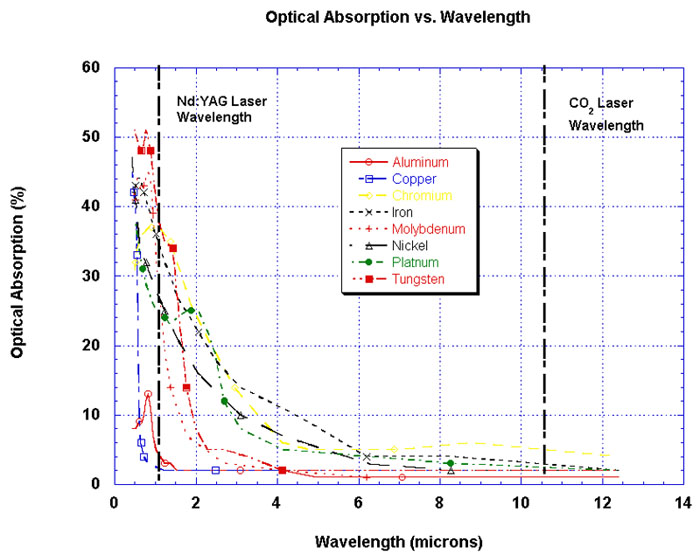
Photo taken from the Handbook
of Optics, Vol. II, published by the Optical Society of America
Products: U.S. Laser designs
and manufactures both High Power
and Low
Order CW Multimode, Pulsed
laser welders, and Turnkey
welding systems. CW welders are excellent for producing continuous seam
butt welds. Pulsed lasers are good for lap welds and spot welding.
In laser cutting, focused
laser light is used as the heat source to both melt and vaporize
material in it's path. Many metals can be cut precisely with a laser by
varying power, feed rate, spot size, and gas type and flow. Laser
cutting is fast, flexible and cost effective.
Model
305-250
Nd:YAG pulsed laser
Cutting 304SS wire mesh 0.030 inches thick
at a 200 watt power level setting.
Products: U.S. Laser designs and
manufactures High Power
CW Multimode lasers and Pulsed lasers
for cutting, as well as Turnkey
cutting systems for cutting many metals up to 1/4 inch thick.
Laser drilling
is the process of removing material to create through holes. Drilling
can be done by percussion or trepanning. Percussion drilling focuses
the beam to a spot equal to the diameter of the hole to be drilled. If
a large hole is required, the laser is moved with respect to the work
piece to form the desired diameter. This is called trepanning. Laser
drilling is ideal for high production volumes. It is cost effective,
and has no drill breakage or tool wear. Nd:YAG lasers have the ability
drill unlimited hole sizes and shapes in a variety of materials
including most metals, ceramics, and semiconductors.
Laser micro-machining is used
to produce very small parts or very small features in parts. It is
similar to cutting and drilling, but on a very small scale. Features as
small as a few microns can be produced using very high peak power short
pulses, but low average power. The resolution of features produced is
proportional to the wavelength used and the beam quality. Materials
that can be micro-machined with Nd:YAG lasers include metals, ceramics,
plastics, glass, laminates and composites.
Products: U.S. Laser designs and
manufactures Q-Switched
TEM00 Mode lasers and Frequency
Multiplied Q-Switched TEM00 Mode
lasers, as well as Turnkey
laser micro-machining systems. In addition, U.S. Laser manufactures
laser micro-machining systems utilizing Spectra-Physics
diode pumped lasers.
The Nd:YAG laser is a very
effective soldering tool in applications where the amount of heat
introduced to the part during the process must be minimized, or where
production throughput requirements dictate a very fast soldering
process.
Lasers are becoming the
method of choice for marking on many different surfaces including most
metals and many plastics. This is because laser marking has clear
advantages over other marking technologies. Printing systems require
ink usage, and hazardous solvent handling and disposal. Tools wear in
stamping systems. Laser marking systems, on the other hand, offer a
clean, low maintenance, easily configured system for permanent marking
of surfaces.
Products:
U.S. Laser offers a range of OEM and Turnkey Nd:YAG laser Marking Systems.
Scribing is very similar to
marking in that lines or characters are produced in the material.
Scribing generally refers to a process where the finished line is the
same as the kerf or beam width. Semiconductor materials and ceramics
are commonly scribed materials.
Nd:YAG lasers are used for
creating conductive traces in a metal layer on photovoltaic panels, and
for scribing panels for breaking to specified sizes. U.S. Laser has
delivered numerous photovoltaic panel processing systems with large,
accurate granite based motion systems.
Products:
U.S.
Laser has been a leader in providing laser scribing systems to the
photovoltaic panel scribing industry for years. Turnkey
Systems with U.S. Laser's lamp pumped Q-Switched
TEM00 Mode and Frequency
Multiplied Q-Switched TEM00 Mode lasers are available. U.S.
Laser also manufactures turnkey systems using Spectra-Physics
supplied diode pumped lasers.
Lasers have the advantage of
being able to heat treat precise areas of metals without involving the
entire work- piece. Laser can provide precise heat input control to
localized areas minimizing distortion, stress and cracking. Laser heat
treating is time efficient, and provides access to hard to reach areas.
The mass of the material being processed is generally sufficient for
rapid heat removal or quenching. The enhanced mechanical and electrical
properties resulting from laser heat treating will depend upon the
composition of the metal or alloy.
Products:High Power
CW Multimode lasers are used for heat treating applications
like annealing and domain refinement.
Direct metal deposition laser
systems are being used for rapid prototyping, repair of expensive
components (like those used in aircraft engines) and manufacturing of
fully dense parts for use as system components. Metal parts are built
up by injecting metal powder into the focused spot of a high power CW
laser beam. The mechanical properties of the finished parts are often
superior to those of parts fabricated from traditional metal-working
techniques. Metal deposition also allows for continuously fabricating
parts from different alloys. U.S. Laser's high power CW multi-mode
laser are used by Optomec Design Company in their Direct Metal
Deposition System. The Optomec system uses the Laser Engineering Net
shaping (LENSTM) process developed at Sandia National Laboratories.
Products:High
Power CW Multimode Nd:YAG lasers are the system of choice for
this exciting new field of direct metal deposition for prototyping,
manufacturing and cladding.
Certain paint stripping and
surface removal applications are ideal for laser systems.
Lasers offer a benefit over chemical stripping applications where waste
disposal, or chemical interaction with the base material is an
issue. Nd:YAG laser stripping can also be done with fiber
optic beam delivery in applications where the area to be treated is
inaccessible to human operators due to the hazardous nature of the
environment or physical inaccessibility.
Products:
The
power/removal ratio in these applications is dependent on peak power
density. Higher peak power density results in more efficient
removal. U.S. Laser's High
Power Multimode Q-Switched Lasers offer very high peak power
density due to short Q-Switched pulses and small spot size achievable
due to high beam quality.
U.S.
Laser maintains an Nd:YAG Laser application lab for processing customer
samples and assisting with process development. Carbon
dioxide (CO2) laser application support is provided through our network
of suppliers.